Floor Melt Melt Micro-Meditation
This Micro-Meditation is an example of the many guided Micro-Meditations you can receive when enrolling for the Micro-Meditation Course.
Techniques Practiced
- Nyasa: means to place
- Shavayatra: means ‘journey around the corpse.’
Description
In this practice, we rotate our awareness around the body. This technique is used in extended meditation practices such as Yoga Nidra. This method of body awareness rotation is derived from yogic techniques called Nyassa and Shavayatra.
Nyasa means ‘to place’ in which seed mantras would be placed in various parts of the body, and Shavayatra means ‘journey around the corpse’.This meditation method can switch off the senses by directing our awareness to the body.
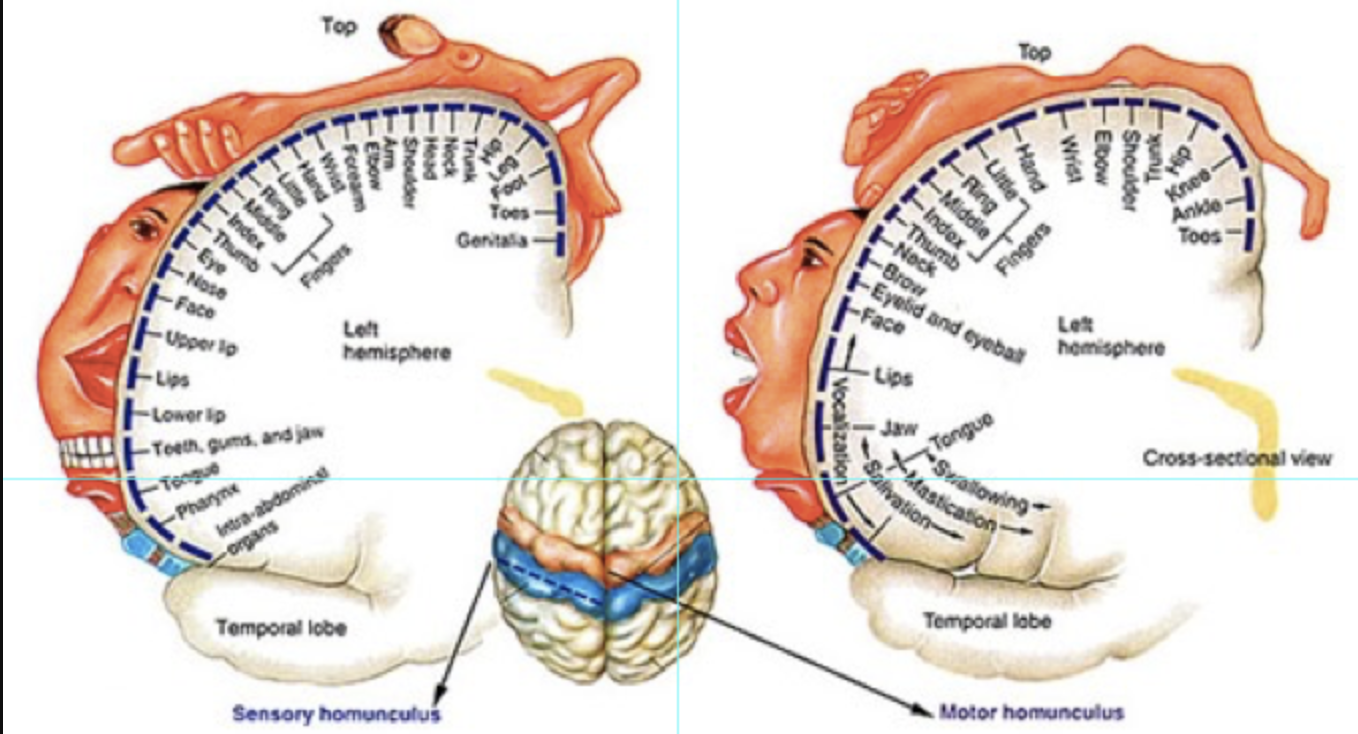
In doing so, we induce a relaxation response with the corresponding part of the homunculus (see image below). The homunculus represents the connection between different body parts and areas in the brain. As we sequence our awareness through the body, the homunculus is systematically switched, which results in profound effects of relaxation.
The size of the body parts shows how much space the brain devotes to processing sensory information from them.
Niyassa Shavayatra - Guided Meditation
Listen with headphones and press play below
How to practise Nyasa Shavayatra
Every Micro-Meditation comes with practice instructions, this can be especially useful when guiding our friends and family see below:
1. Close your eyes and find yourself in a comfortable position, preferably lying in the Savasana ‘corpse pose’ position. Ensure your feet are hip-width apart. For added comfort, you may place a pillow under your knees and head.
2. Ensure you listen to someone who will recite each body part. Doing this meditation is best performed under guidance, allowing the brain to be purely focused on listening. As you hear each body part mentioned, shine your awareness on that part of the body and mentally repeat it.
3. Awareness will move to the right side of the body starting with:
- Right-hand thumb
- Index finger
- Middle finger
- Ring finger
- Little finger
- The palm of the hand
- Back of the hand
- Wrist
- Lower arm
- Elbow
- Upper arm
- Shoulder
- Armpit
- The right side of the chest
- Waist
- Right hip
- Thigh
- Knee
- Shin
- Ankle
- Sole of the right foot
- Top of the foot
- Right big toe
- Shine your awareness to the whole right side of the body.
4. Awareness will now move to the left side of the body. Bring your attention to the:
- Left-hand thumb
- Index finger
- Middle finger
- Ring finger
- Little finger
- The palm
- Back of the hand
- Wrist
- Lower arm
- Elbow
- Upper arm
- Shoulder
- Armpit
- The left side of the chest
- Waist
- Left hip
- Thigh
- Knee
- Shin
- Ankle
- Sole of the left foot
- Top of the foot
- Left big toe
- Now bring your awareness to the whole left side of the body.
5. Continue to rotate your awareness back side of the body:
- Right heel
- Left heel
- Right calf
- Left calf
- Back of right knee
- Back of left knee
- Back of right thigh
- Back of left thigh
- Right buttock
- Left buttock
- The spinal column, from tailbone to midbrain
- Midbrain to tailbone
- Lower back
- Middle back
- Upper back
- Right shoulder blade
- Left shoulder blade
- Back of neck
- Back of head
6. Moving your awareness to the front side of the body, continue to rotate your attention to the:
- Top of head
- Forehead
- Right temple
- Left temple
- Right eyebrow
- Left eyebrow
- Eyebrow centre
- Right eye
- Left eye
- Right ear
- Left ear
- Right cheek
- Left cheek
- Bridge of nose
- Tip of nose
- Right nostril
- Left nostril
- Both nostrils
- Whole nose
- Upper lip
- Lower lip
- The line where lips meet
- Both lips together
- Teeth
- Tongue
- Gums
- Whole mouth
- The right side of the jaw
- The left side of the jaw
- Chin
- Front of neck
- Throat pit
- Right collarbone
- Left collarbone
- The right side of the chest
- The left side of the chest
- Heart centre
- Upper abdomen
- Lower abdomen
- Navel centre
- The right side of the pelvis
- The left side of the pelvis
- Pelvic floor
- Whole pelvic area
8. Now guide your awareness to the significant parts of the body. Awareness moves the:
- Whole right leg and foot
- Entire left leg and foot
- Both legs and feet together
- Entire right arm and hand
- Entire left arm and hand
- Both arms and hands together
- Whole torso
- Neck and head
- Torso, neck and head together
- Whole right side
- Whole left side
- Whole back
- Whole front
- Whole body together...
- Whole body together...
- Whole body together…
9. Slowly come back to your breath and hear the sounds in your environment. Know what is making those sounds. Gently open your eyes.
Benefits of Nyasa Shavayatra
Deep Relaxation
Withdrawal of the senses (pratyahara)
Improved inner awareness
Here is what people think of Micro-Meditation

Learn 30+ Yogic Breathwork & Meditation Techniques
Learn a comprehensive set of practices to take ownership of your life, detailed below:

Antar Mouna Meditation
Explore your relationship with the senses & thoughts and learn to detach

Full Yogic Breath Pranayama
Tune your breath to awaken your nervous system and mind

Ujjayi Breath Pranayama
Relax the body and mind whilst maintaining conscious awareness

Mantra Jappa Meditation
Stabilise the restless mind and improve your ability to concentrate

Natural Breath Awareness
Utilise the breath to activate the parasympathetic (rest & digest) response

Kaki Pranayama
Used to cool the body and the mind and dispel any fatigue and restlessness

Nadi Shodhana Pranayama
Utilise nostril breathing to balance energy in the physical and mental body

Bhramari Pranayama
Move below surface level thoughts where awareness is calm and present

Kaya Sthariyium Meditation
Create stability and ease in the body for effective meditation

Surya Bhedana Pranayama
Create tension in the body via the sympathetic (fight-flight) response

Ajapa Japa Meditation
Used to build concentration and still any disturbances in the mind

Chakra Meditation
An emotional self-analysis system used to grow past our shortcomings

Progressive Muscle Relaxation
Manipulate the breath with awareness to fall into a state of deep relaxation

Kapalbathati Pranayama
Utilise the breath to awaken peak mind performance ready for any challenge

Chandra Bhendana Pranayama
Used to calm our emotions and slow down the mind

Chidakasha Dharina Meditation
Cultivate our ability to concentrate and improve our memory and imagination

Nyasa Shavayatra Meditation
.Learn how to switch off the senses by directing our awareness to the body

Sankalpa Meditation
Create positive behavioural changes
and achieve life purpose

Trataka Meditation
Utilise eye gazing to develop concentration & memory

Viloma Pranayama
Expand lung capacity and increase breath duration.
What to expect
Micro-Meditation practice can lead to the following:
A newfound sense of calmness. You will find things that used to trigger you to have less power over you as you adopt a non-reactive mindset.
As you release destructive old-world habits and behaviours, higher awareness will begin to form.
Increase concentration power as you learn how to direct focused attention creating a steady mind, one that is mentally and emotionally resilient
A better understanding of your inner world of thought and what shapes and influences it
Improved energy and vitality through the practice of breath control and direction
A relaxed state of being as you begin to learn how to hack your nervous system and effortlessly shift fight and fight (sympathetic) response to rest and digest (parasympathetic)
$99/$399 USD
75% off exclusive deal


Hi, I am Jan
Yogi & Meditation Teacher
I believe mind mastery is the most important skill we can learn in our lifetime.
Utilising yogic wisdom I created Micro-Meditation as a helpful practice to bring us into the present moment allowing us to think and feel more clearly throughout the day.
People use meditation to achieve self-exploration, and spiritual enlightenment, improve their well-being and enhance their mental and emotional state. Unfortunately, due to our busy lifestyles, we lack time to focus on meditation.
You do not need to be a monk meditating for hours to achieve the benefits of meditation. You simply need to practice. Practice is just repetition over a long period.
Micro-Meditation is a structured practice where you can experience the life-changing benefits of meditation without needing to commit hours to meditate. Anyone can find 5 minutes in their busy day.
Frequently Asked Questions.
Email us at hello@micromeditationcourse.com for more information
The key to meditation is consistency. You will find greater benefits if you practice shorter meditations every day vs a longer meditation every other day.
Guided meditations are the best way to learn the fundamentals of meditation. Once you learn how to meditate properly you will find that guided meditations are no longer needed.
No
The issue with other applications is that they rarely teach you how to meditate effectively, their goal is to make you dependent on their subscription service. The Micro-Meditation Course is designed to teach you the fundamentals for an effective meditation practice you can easily implement in your life.
There are many reasons why you should consider learning to meditate. Some of the potential benefits of meditation include:
Reducing stress and anxiety: Meditation can help to calm the mind and body, and it can be an effective way to reduce stress and anxiety. By focusing on the present moment and letting go of worries and concerns, meditation can help you to feel more relaxed and at peace.
Improving concentration and focus: Meditation can also help to improve concentration and focus. By training the mind to stay present and focused on a specific object or sensation, meditation can help to improve your ability to concentrate and pay attention.
Promoting physical health: In addition to its mental and emotional benefits, meditation can also have positive effects on physical health. Meditation can help to reduce blood pressure, improve sleep, and boost the immune system, among other benefits.
Enhancing overall well-being: Overall, meditation can help to promote a sense of well-being and balance in your life. By regularly practicing meditation, you can cultivate a sense of inner peace and tranquility, and you can learn to respond to challenges and stress with greater calm and clarity.
By learning to meditate, you can potentially experience a range of benefits that can improve your mental, emotional, and physical well-being.
Meditation can potentially be helpful for weight loss, but it is not a magic solution and should not be used as a replacement for a healthy diet and regular exercise. However, meditation can potentially help with weight loss in the following ways:
Reducing stress and emotional eating: Meditation can help to reduce stress and anxiety, which can in turn help to prevent emotional eating. By calming the mind and promoting a sense of inner peace, meditation can help to reduce the likelihood of reaching for food as a way to cope with stress or negative emotions.
Improving self-awareness and mindfulness: Meditation can also improve self-awareness and mindfulness, which can be beneficial for weight loss. By becoming more aware of your thoughts, emotions, and behaviors, you can learn to make healthier choices and to better understand your motivations for eating.
Increasing motivation and self-control: Meditation can also increase motivation and self-control, which can be helpful for sticking to a healthy diet and exercise plan. By practicing meditation, you can cultivate a sense of discipline and commitment, which can help you to stay motivated and on track with your weight loss goals.
Overall, while meditation alone is not enough to cause weight loss, it can be a useful tool to support a healthy lifestyle and weight loss efforts.
In general, meditation is considered to be a safe and beneficial practice, and it has been used for centuries to promote mental and physical well-being. However, like any other activity, meditation can have potential risks or drawbacks, depending on the individual and the specific circumstances. Some potential risks or drawbacks of meditation include:
Overdoing it: It is possible to overdo meditation, especially if you are new to the practice or if you have existing mental or physical health conditions. It is important to start slowly and gradually build up your meditation practice, and to listen to your body and mind to avoid overdoing it.
Releasing suppressed emotions: Meditation can also potentially release suppressed emotions or memories, which can be challenging to process. If you have a history of trauma or other emotional challenges, it is important to seek guidance from a qualified meditation teacher or therapist to ensure that you are able to safely and effectively work through any difficult emotions that may arise.
Risk of injury: In rare cases, meditation can also lead to physical injury if it is not practiced properly. For example, some meditation postures or practices may put strain on the body, and it is important to be mindful of your body's limitations and to avoid pushing yourself too hard.
Overall, while meditation is generally considered to be safe, it is important to be mindful of potential risks and drawbacks, and to seek guidance from a qualified teacher or therapist if needed.
Yes, meditation can potentially be helpful for individuals with ADHD (attention deficit hyperactivity disorder). Research has shown that meditation can help to improve focus, concentration, and attention, which can be beneficial for individuals with ADHD. Meditation can also help to reduce stress and anxiety, which are common comorbidities of ADHD. Additionally, meditation can improve overall well-being and promote a sense of calm and balance, which can be helpful for managing the symptoms of ADHD.
Yes, meditation can potentially be helpful for individuals with depression. Research has shown that meditation can have a positive impact on mental and emotional well-being, and it can be an effective tool for managing depression and other mood disorders. Meditation can help to reduce stress and anxiety, which are common symptoms of depression. It can also promote a sense of inner peace and contentment, and can improve overall well-being.
If you have depression and are interested in trying meditation, it is important to seek guidance from a qualified meditation teacher or therapist who has experience working with individuals with depression. They can help you to learn meditation techniques that are specifically tailored to your needs and can provide support and guidance as you begin your meditation practice. It is also important to continue to seek medical treatment for your depression, and to talk to your doctor about incorporating meditation into your overall treatment plan.
Meditation has been shown to have a number of potential health benefits, but it is important to remember that it is not a cure-all and should not be used as a replacement for medical treatment. However, meditation can potentially help to heal the body in the following ways:
Reducing stress and promoting relaxation: Meditation can help to reduce stress and promote relaxation, which can have positive effects on the body. By calming the mind and body, meditation can help to lower blood pressure and heart rate, and can also boost the immune system.
Improving sleep: Meditation can also improve sleep, which is important for overall physical health. By practicing relaxation techniques, meditation can help to promote a restful and restorative sleep.
Managing chronic pain: Meditation can also be helpful for managing chronic pain. By focusing on the present moment and letting go of worries and concerns, meditation can help to reduce the perception of pain, and can also promote a sense of calm and relaxation.
Enhancing overall well-being: Overall, meditation can help to promote a sense of well-being and balance in the body. By regularly practicing meditation, you can cultivate a sense of inner peace and tranquility, and you can learn to respond to physical sensations and challenges with greater calm and clarity.
Overall, while meditation cannot cure physical ailments or conditions, it can be a useful tool to support physical health and well-being.
Yes, meditation can potentially be helpful for individuals with anxiety. Research has shown that meditation can help to reduce stress and anxiety, and can also promote a sense of inner peace and relaxation. By training the mind to focus on the present moment and let go of worries and concerns, meditation can help to calm the mind and reduce anxiety.
Yes, meditation can potentially help to lower blood pressure. Research has shown that meditation can have a positive impact on physical health, and it can be an effective tool for managing high blood pressure. By reducing stress and promoting relaxation, meditation can help to lower blood pressure and improve overall cardiovascular health.
If you have high blood pressure and are interested in trying meditation, it is important to talk to your doctor and seek guidance from a qualified meditation teacher or therapist. They can help you to learn meditation techniques that are specifically tailored to your needs and can provide support and guidance as you begin your meditation practice. It is also important to continue to follow your doctor's recommendations for managing your blood pressure, and to incorporate meditation into your overall treatment plan.
No, meditation cannot replace sleep. Sleep is essential for physical and mental health, and it is important to prioritize getting enough sleep each night. While meditation can promote relaxation and help to improve sleep, it cannot replace the restorative effects of sleep on the body and mind.
Meditation can be a useful tool to support healthy sleep, but it is not a replacement for sleep. It is important to continue to prioritize getting enough sleep each night, and to seek medical help if you are experiencing sleep difficulties or disorders.
Meditation works by training the mind to focus on the present moment and to let go of worries and concerns. By regularly practicing meditation, you can develop the ability to quiet the mind and let go of distracting thoughts and emotions. This can help to reduce stress and anxiety, and can promote a sense of inner peace and well-being.
Meditation also works by activating the relaxation response, which is the body's natural response to relaxation and stress reduction. When you meditate, your body and mind relax, and your heart rate, breathing rate, and blood pressure all decrease. This can help to reduce the physical effects of stress on the body, and can promote overall physical and mental well-being.
Overall, meditation works by training the mind to be present and focused, and by activating the relaxation response in the body. These effects can help to reduce stress and anxiety, and can promote overall well-being.
Created with love | Terms & Privacy Policy
Subscribe here for free
We HATE spam. Your email address is 100% secure